From kickoff to booked meetings in about two weeks.
Here is the entire campaign timeline, including the parts where nothing looks like it is happening.
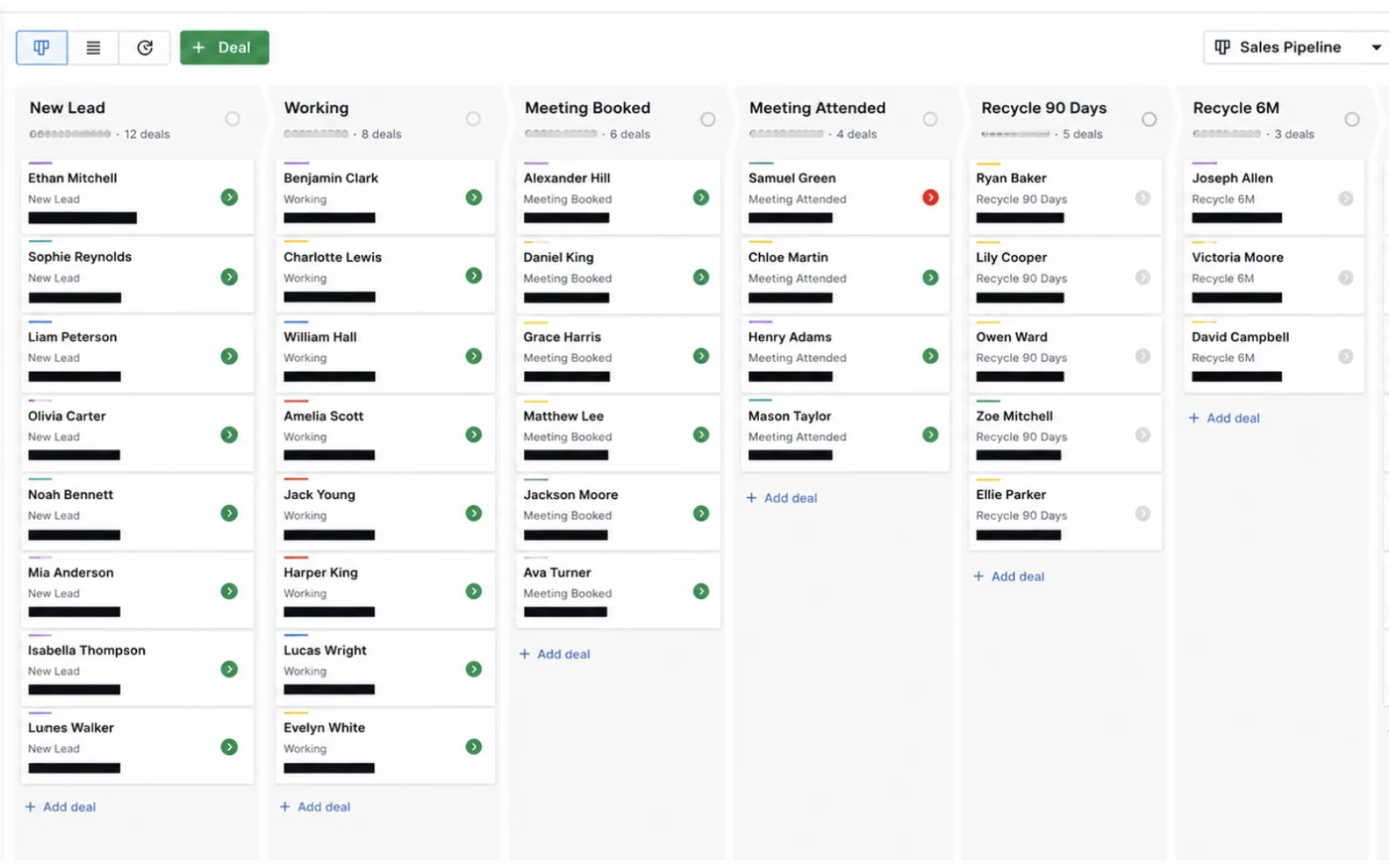
Every deal, every stage, visible to you in the CRM.
Six weeks, week by week.
Dates shift with how fast onboarding gets done on your side. The order does not change.
Kickoff and ICP workshop
We work backwards from your closed won accounts to define who is worth calling. We agree the qualification standard in writing, including what will not be billed. CRM access, calendar access and dialler configuration are set up in the same week.
List build and script approval
The list is built, verified and deduplicated against your CRM. Existing customers and live opportunities are suppressed. The script, opener and rebuttals are written and sent to you. Nothing is dialled until you have signed off.
Dialling begins
Setters start calling. Every call is recorded, every disposition is logged the same day. We are watching connect rate by segment and how far the opener gets before the objection lands.
First meetings and the first rewrite
First booked meetings typically land in this window, sometimes earlier. The script gets its first real rewrite based on recordings. Segments that are not connecting get less dial time.
Momentum
Weekly volume stabilises. Your closers start giving feedback on meeting quality, which is what corrects qualification drift. This is the first point at which the campaign can be judged fairly.
Iterate, or stop
Every week you get the report and the review. If the segment is not answering, we say so. If we think the campaign should not continue in its current shape, we will tell you that too.
Why you get a weekly report and not a daily dashboard.
Because daily outbound data is noise. Connect rate swings hard on a Tuesday against a Thursday, on a school holiday, on the day a competitor announces something. A day of dials is not a sample. It is an anecdote.
A week is the smallest window where the numbers mean something you can act on. So the report lands weekly and covers dials, connects, conversations, bookings, shows, objection themes and what we are changing next week.
The raw dispositions are in the CRM in real time if you want to look at them. What you get weekly is the read, not the raw feed.
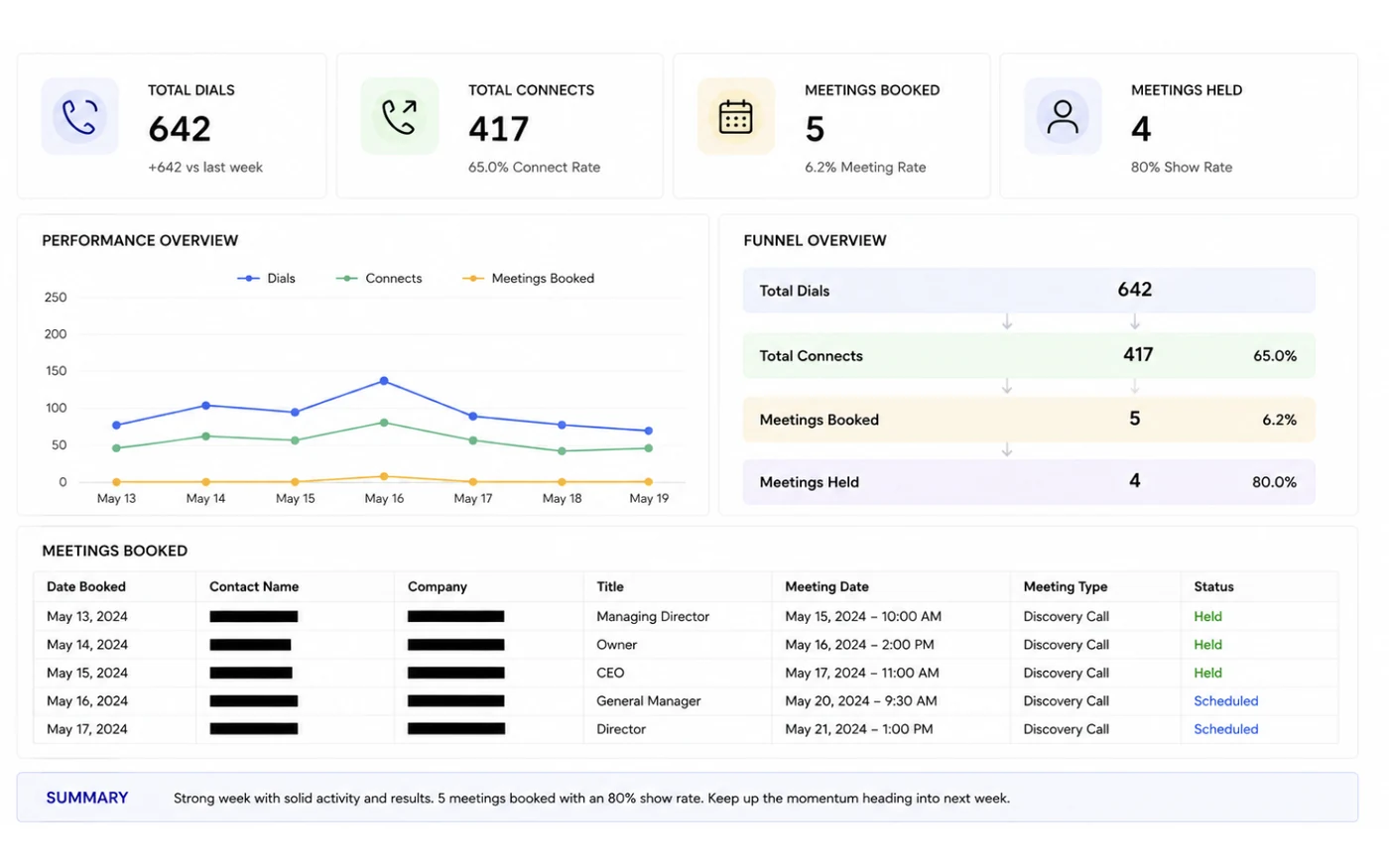
Sent every week, good week or bad, with denominators attached.
A booked meeting is not a confirmed meeting.
Between the moment a prospect agrees to a time and the moment they actually turn up, most of the loss happens. Three touches sit in that gap.
- On the call. The time is agreed out loud, the calendar invite goes out while the prospect is still on the phone, and they confirm they have received it.
- Between booking and the day before. A written confirmation restating who is attending and what will be covered.
- Shortly before the meeting. A final confirmation, with a rebooking offer rather than a silent no-show if the time no longer works.
Alongside that, your closer receives the handoff brief so the meeting does not open with questions the prospect already answered on the phone.
Questions about the process
How much of our time does onboarding take?
About three hours in week zero, then roughly an hour a week.
The ICP workshop and the script sign-off are the two places we need you properly engaged. Everything after that runs on the weekly review.
What if the first script does not work?
It usually does not work entirely, and that is expected. Week two exists to fix it.
Rewrites come off the recordings: which openers get past ten seconds, which objections repeat, which segments answer at all. Opinions about what should work are the slowest way to find out.
When do we know whether it is working?
Week six is the earliest honest read.
By then the script has stabilised and you have enough meetings to judge quality, not just volume. Judging a campaign at week two measures the calibration period, which tells you almost nothing.
Tell us what you sell and we will tell you straight.
Send the details and you get a reply within one business day: your ICP, your average contract value and your close rate, then a plain answer on whether we would take the campaign.